
Martin Abel
Peter M. Small Associate Professor of Economics, Bowdoin College
I am a development, labor and behavioral economist. Much of my work uses field and online experiments to study discrimination and gender in labor markets, how people search for jobs, and how behavioral tools can change what people do. A lot of it is set in South Africa, with projects in India, Mexico and Saudi Arabia.
I am a Research Fellow at IZA and an Affiliate at J-PAL. I hold a PhD and an MPA in International Development from Harvard University and a Diplom from the University of Jena.
Research
Recent publications
Recent working papers
All papers
We examine how reminders for self-set goals influence productivity by analyzing data from 10,187 volunteer agricultural extension workers in Rwanda. We elicited workers' goals and experimentally varied their salience through text reminders. Due to unforeseen logistical delays, approximately half of the treatment group received reminders after completing their tasks. We find that goal reminders received during the regular working period increased a productivity index by 0.08 standard deviations, while reminders sent late had no effect. Further analysis of heterogeneity by goal ambition quartiles reveals an inverted U-shaped relationship: reminders are effective for goals in the second and third quartiles, but ineffective for low or excessively high goals. These results suggest that workers who set ambitious yet realistic goals are more likely to respond to reminders and increase productivity, consistent with prior evidence on externally set goals.
@article{abel2026effect,
  author = {Abel, Martin and Harigaya, Tomoko and Kremer, Michael and Zhu, Jessica},
  title = {The Effect of Reminders for Self-Set Goals on Productivity},
  journal = {Journal of Development Economics},
  year = {2026},
  doi = {10.1016/j.jdeveco.2026.103822}
}
We investigate the extent and underlying mechanisms behind race beliefs on hiring decisions. In an incentivized experiment, workers with names perceived to be Black are 30 percentage points less likely to be hired. Results indicate that race serves as a decision heuristic: large perceived race gaps among candidates lead to faster and more confident decisions, and the race gap in hiring increases by 25% when employers are forced to make quick decisions. Estimates from a drift-diffusion model reveal that most employers initially focus on worker race, but certain employer groups shift their attention to productivity-related attributes when given sufficient time.
@article{abel2026namebased,
  author = {Abel, Martin and Burger, Rulof},
  title = {Name-Based Race Discrimination: The Role of Heuristics},
  journal = {Review of Economics and Statistics},
  year = {2026},
  doi = {10.1162/REST.a.1706}
}
We study the effect of monetary incentives on effort in a prosocial task: writing letters encouraging voter turnout. Volunteers are randomized to receive no incentive, unconditional upfront payment, payment conditional on completing the task, or to have a choice between the two payment schemes. The unconditional and conditional payment both increase task completion rates by about 18 percentage points (43%). Giving people a choice between the payment scheme doubles the effect on task completion (35 p.p., 84%). Unlike unconditional payments, a choice over contracts also increases time spent on the task and letter quality. Survey responses suggest that giving people a choice is effective because it increases task ownership rather than the desire to return a favor or avoid feelings of guilt.
@article{abel2026choice,
  author = {Abel, Martin and Burger, Rulof},
  title = {Choice over Payment Schemes and Worker Effort},
  journal = {Experimental Economics},
  year = {2026}
}
This study experimentally investigates the role of politics in hiring decisions. Participants acted as employers, determining the highest wage to offer candidates based only on their demographic characteristics, education, and partisanship. We find that both Democratic and Republican participants significantly favor co-partisans, with an out-partisan wage penalty of 7.5%. Discrimination is consistent across tasks that focus respectively on competence, shirking, feedback responsiveness, and voluntary effort, and appears largely driven by biased beliefs about partisan productivity, while affective polarization is also predictive of the out-partisan wage penalty. Discrimination does not increase in a treatment where workers benefit financially from being hired.
@article{abel2026partisan,
  author = {Abel, Martin and Robbett, Andrea and Stone, Daniel},
  title = {Partisan Discrimination in Hiring},
  journal = {Journal of Human Resources},
  year = {2026},
  doi = {10.3368/jhr.1124-13970R2}
}
This study experimentally tests the impact of providing information about vaccine safety and efficacy delivered by Black health care professionals. We find that providing general information increases vaccination rates after 5 months by 8 percentage points (17%), driven by a 9.8 pp (24%) increase among white participants. Political affiliation emerges as a key moderator to explain this discordant effect. Across race, general information is more effective for politically moderate and conservative respondents, most of whom are white. Among this most vaccine-hesitant group, the information effectively addresses concerns about both side effects and unknown long-run effects due to the fast approval of the vaccine, increasing vaccination rates by 14 pp.
@article{abel2025effect,
  author = {Abel, Martin and Byker, Tanya and Carpenter, Jeffrey},
  title = {The Effect of Information From Black Health Care Professionals on COVID Vaccination Take-Up},
  journal = {Health Economics},
  year = {2025},
  doi = {10.1002/hec.70020}
}
We conduct an incentivized experiment with a nationally representative sample to investigate gender discrimination among people receiving advice on risky investments. Participants learn about actual start-up firms they can invest in. Before deciding how much of their endowment to invest, they receive recommendations from either female or male professionals. We find that before outcomes are revealed, participants are equally likely to follow recommendations of female and male advisors. Likewise, we observe no gender discrimination following advice that proves correct. However, for advice that turns out to be incorrect, advisor gender significantly impacts the decisions made by male participants. They invest 47% less in the direction of this advice compared to situations where male advisors were incorrect. These differences are not explained by participants' stated views on gender roles and advisors' ability as well as the level of attention towards female advisors.
Coauthored with Bowdoin students: Emma Bomfim, Izzy Cisneros, Jackson Coyle, Song Eraou, Martha Gebeyehu, Gerardo Hernandez, Julian Juantorena, Lizzy Kaplan, Danielle Marquez, Jack Mullen, Peyton Mulhern, Ayana Opong-Nyantekyi, Rin Osathanugrah, Joe Paul, Austin Philie, Luke Tingley, Jingyi Wang.
@article{abel2024women,
  author = {Abel, Martin and others},
  title = {Are Women Blamed More for Giving Incorrect Financial Advice?},
  journal = {Journal of Economic Behavior & Organization},
  year = {2024},
  doi = {10.1016/j.jebo.2024.106781}
}
We hire 2,228 Indian gig-economy workers for a real-effort transcription task and randomize the gender of the (fictitious) manager as well as the delivery of performance feedback. We find that negative feedback (i.e., criticism) leads to moderate deterioration in worker attitudes, but it increases effort provision in both mandatory and voluntary tasks. By contrast, praise affects neither attitudes nor effort provision. Importantly, feedback effects do not vary between workers assigned to female and male managers. Consistent with this finding, there is no evidence for attention discrimination toward female managers, implicit gender bias, or gendered expectations among workers. By contrast, Abel (J. Human Resources 59, no. 2:470–501, 2024) employs the same research design in the United States and finds substantial gender discrimination and no effect of feedback on effort. This highlights that the effects of feedback and manager gender vary across different contexts.
@article{abel2024effect,
  author = {Abel, Martin and Buchman, Daniel},
  title = {The Effect of Manager Gender and Performance Feedback: Experimental Evidence from India},
  journal = {Economic Development and Cultural Change},
  year = {2024},
  doi = {10.1086/727513}
}
In public good provision and other collective action problems, people are uncertain about how to balance self-interest and prosociality. Actions of others may inform this decision. We conduct an experiment to test the effect of watching private citizens and public officials acting in ways that either increase or decrease the spread of the coronavirus. For private role models, positive examples lead to a 34% increase in donations to the CDC Emergency Fund and a 20% increase in learning about COVID-19-related volunteering compared to negative examples. For public role models these effects are reversed. Negative examples lead to a 29% and 53% increase in donations and volunteering, respectively, compared to positive examples.
@article{abel2022prosocial,
  author = {Abel, Martin and Brown, Willa},
  title = {Prosocial Behavior in the Time of COVID-19: The Effect of Private and Public Role Models},
  journal = {Journal of Behavioral and Experimental Economics},
  year = {2022},
  doi = {10.1016/j.socec.2022.101942}
}
I hire 2,700 workers for a transcription job, randomly assigning the gender of their (fictitious) manager and provision of performance feedback. While praise has no effect, criticism negatively impacts workers' job satisfaction and perception of the task's importance. When female managers deliver this feedback, negative effects on these attitudes double in magnitude. Having a critical female manager does not affect effort provision, but it lowers workers' interest in working for the firm in the future. Results are consistent with gendered expectations of feedback. I find no evidence for the role of attention discrimination or implicit gender bias.
@article{abel2024workers,
  author = {Abel, Martin},
  title = {Do Workers Discriminate against Female Bosses?},
  journal = {Journal of Human Resources},
  year = {2024},
  doi = {10.3368/jhr.1120-11318R3}
}
This paper collects a unique data set of classified ads and exploits quasi-random variation in the applicant pool composition to show that there exists hiring discrimination against immigrants in South Africa's informal sector. Consistent with a tournament models in which immigrants are penalised, I find that both immigrant and native job seekers receive more employer clicks on their profile when being pooled with immigrant job applicants. Results also show that immigrants search further away, especially if they live in areas with high employer discrimination. This spatial sorting presents an important cost of discrimination that has largely been ignored in the literature.
@article{abel2023labor,
  author = {Abel, Martin},
  title = {Labor Market Discrimination and Sorting: Evidence from South Africa},
  journal = {Journal of African Economies},
  year = {2023},
  doi = {10.1093/jae/ejac013}
}
The perception of risk affects how people behave during crises. We conduct a series of experiments to explore how people form COVID-19 mortality risk beliefs and the implications for prosocial behavior. We first document that people overestimate their own risk and that of young people, while underestimating the risk old people face. We show that the availability heuristic contributes to these biased beliefs. Using information about the actual risk to debias people's own risk perception does not affect donations to the Centers for Disease Control but does decrease the amount of time invested in learning how to protect older people. This constitutes a debiasing social dilemma. Additionally providing information on the risk for the elderly, however, counteracts these negative effects. Importantly, debiasing seems to operate through the subjective categorization of and emotional response to new information.
@article{abel2021socially,
  author = {Abel, Martin and Byker, Tanya and Carpenter, Jeffrey},
  title = {Socially Optimal Mistakes? Debiasing COVID-19 Mortality Risk Perceptions and Prosocial Behavior},
  journal = {Journal of Economic Behavior & Organization},
  year = {2021},
  doi = {10.1016/j.jebo.2021.01.007}
}
We show that reference letters from former employers alleviate information frictions in a low-skill labor market, improving applicant screening and gender equity. A resume audit study finds that using a reference letter in the application increases callbacks by 60 percent. Women drive the effect. Letters are effective because they provide valuable information about workers' skills that employers use to select applicants of higher ability. A second experiment, which encourages job seekers to obtain and use a reference letter, finds consistent results. In particular, reference letters raise job interviews and employment for women.
@article{abel2020value,
  author = {Abel, Martin and Burger, Rulof and Piraino, Patrizio},
  title = {The Value of Reference Letters: Experimental Evidence from South Africa},
  journal = {American Economic Journal: Applied Economics},
  year = {2020},
  doi = {10.1257/app.20180666}
}
The paper tests the effects of plan making on job search and employment. In a field experiment with unemployed youths, participants who complete a detailed job search plan increase the number of job applications submitted (by 15 percent) but not the time spent searching, consistent with intention-behavior gaps observed at baseline. Job seekers in the plan-making group diversify their search strategy and use more formal search channels. This greater search efficiency and effectiveness translate into more job offers (30 percent) and employment (26 percent). Weekly reminders and peer support sub-treatments do not improve the impacts of plan making.
@article{abel2019bridging,
  author = {Abel, Martin and Burger, Rulof and Carranza, Eliana and Piraino, Patrizio},
  title = {Bridging the Intention-Behavior Gap? The Effect of Plan-Making Prompts on Job Search and Employment},
  journal = {American Economic Journal: Applied Economics},
  year = {2019},
  doi = {10.1257/app.20170566}
}
This paper tests experiential learning as a debiasing tool to reduce gambling in South Africa, through a randomized field experiment. The study implements a simple, interactive game that simulates the odds of winning the national lottery through dice rolling. Participants first roll one die until they obtain a six, followed by two dice until they roll 2 sixes. They are then informed that the probability of winning the lottery jackpot is equivalent to rolling all sixes with nine dice. The results show that individuals who need many attempts to roll 2 sixes play the lottery significantly less than the control group, while those who need fewer attempts adopt the opposite behavior. These findings provide practical guidance for designing interventions to give individuals brief experiences that correct biases in their beliefs.
@article{abel2021changing,
  author = {Abel, Martin and Cole, Shawn and Zia, Bilal},
  title = {Changing Gambling Behavior through Experiential Learning},
  journal = {World Bank Economic Review},
  year = {2021},
  doi = {10.1093/wber/lhaa016}
}
In an attempt to divide and marginalize the black population, the apartheid regime forcefully relocated some 3.5 million South Africans to rural homelands between 1960 and 1980. This event, considered one of history's largest social engineering exercises, created overcrowded and economically deprived communities of displaced people. This article uses geo-coded data to explore the long-term effects of removals on current measures of social capital. Comparing people within the same homeland, I show that those living close to former resettlement camps have higher levels of trust towards members of their social network, people in general, and members of other ethnic groups. These findings are important, as solidarity among suppressed people is believed to be a critical factor in explaining the demise of the apartheid regime.
@article{abel2019longrun,
  author = {Abel, Martin},
  title = {Long-Run Effects of Forced Resettlement: Evidence from Apartheid South Africa},
  journal = {Journal of Economic History},
  year = {2019},
  doi = {10.1017/S0022050719000512}
}
Using South Africa's first nationally representative panel data set, I find that the presence of pension recipients in the household reduces the probability of employment of both previously employed and unemployed prime-aged adults. Exploiting institutional features of the disability grant to isolate the pension's income effect suggests that the effects operate through the income mechanism. By contrast, there is no evidence that pensioners enable household members to work by providing childcare as concluded by previous studies.
@article{abel2019unintended,
  author = {Abel, Martin},
  title = {Unintended Labor Supply Effects of Cash Transfer Programs: New Evidence from South Africa's Pension},
  journal = {Journal of African Economies},
  year = {2019},
  doi = {10.1093/jae/ejz009}
}
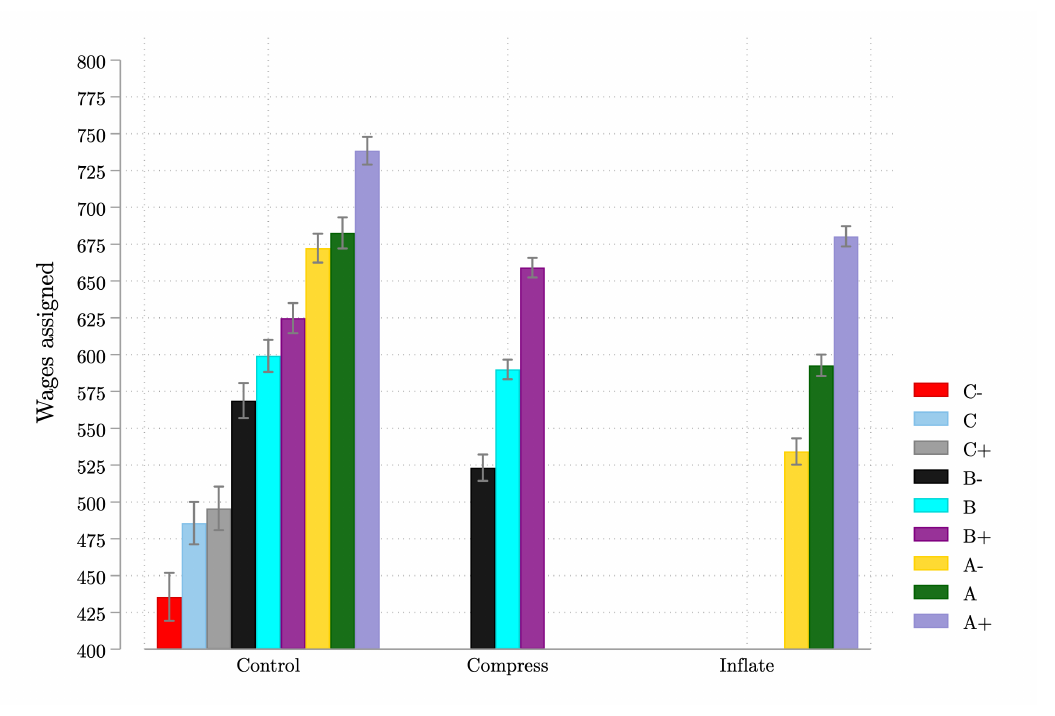
We study how grading policies shape employers' interpretations of labor market signals embedded in academic credentials. In our experiment, hiring managers observe letter grades assigned to math tests taken by job candidates and make wage offers to match their beliefs about each candidate's underlying ability. We exogenously vary the coarseness of the grading scheme while holding candidate performance constant. As predicted, coarser grading leads managers to place less weight on grade signals and more on prior beliefs, reducing match efficiency. Departing from predictions, managers extract systematically higher signals from inflated grades, behaving as if candidates with As represent a positively selected pool. Furthermore, managers place greater decision weight on inflated As than on compressed Bs, creating a compounding wage advantage for candidates even though grade inflation is common knowledge. Considering the broader implications of our results, the shift toward prior-based evaluation under coarser grading falls disproportionately on female candidates, contributing to a wider gender wage gap among managers with gendered priors.
@techreport{abel2026grade,
  author = {Pu, Zhizhong and Abel, Martin and Carpenter, Jeffrey P.},
  title = {Grade Inflation and the Interpretation of Labor Market Signals},
  institution = {IZA},
  note = {IZA DP 18654},
  year = {2026}
}
Inflated grades lead to higher wages: managers offer candidates more on average under inflated grading than under standard or compressed grading, even though candidate ability is the same. Coarser grading also flattens wage offers, paying top candidates less and weaker candidates more.
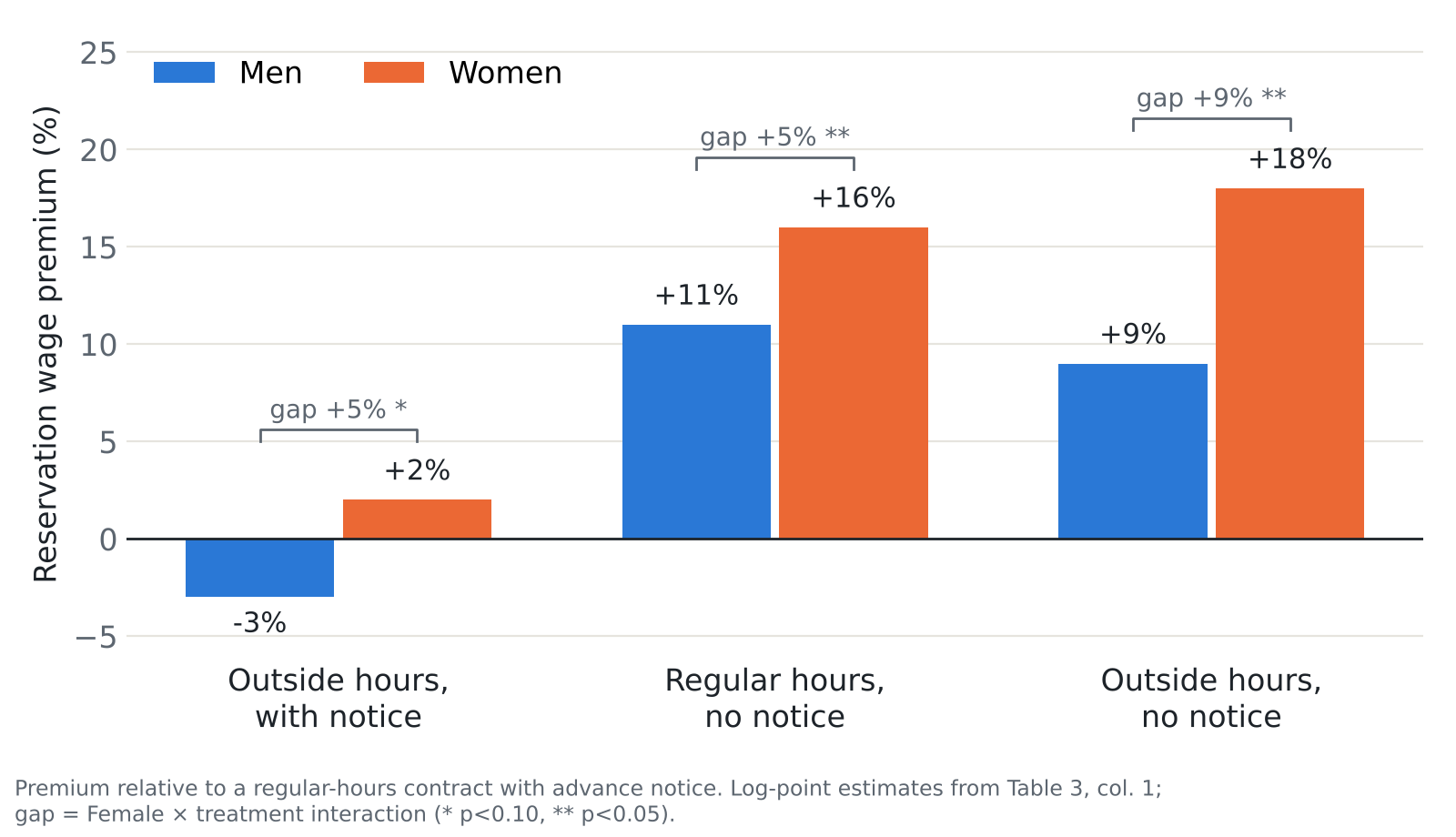
We study how scheduling demands shape gig-work supply and its composition in an experiment with U.S. gig workers, eliciting reservation wages for contracts varying in advance notice, timing, and duration. No-notice contracts raise reservation wages by 13–14 percent, while outside-hours work with notice carries little penalty. Women require 5–6 percent more than men for outside-hours or no-notice work, and 8–9 percent more when combined. These gaps are largest among workers with heavy household-chore burdens and inflexible schedules. Higher-productivity workers also require larger no-notice premiums. At a given wage, demanding contracts therefore reduce labor supply and select a lower-productivity labor pool.
@techreport{abel2026price,
  author = {Jha, Natasha and Abel, Martin and Piraino, Patrizio},
  title = {The Price of Unpredictability: Scheduling Demands, Gender and Selection in the Gig Economy},
  institution = {IZA},
  note = {IZA DP 18976},
  year = {2026}
}
Women need a larger pay increase than men to accept unpredictable jobs. For outside-hours, no-notice work, the wage women require to accept rises about 18%, compared with 9% for men.
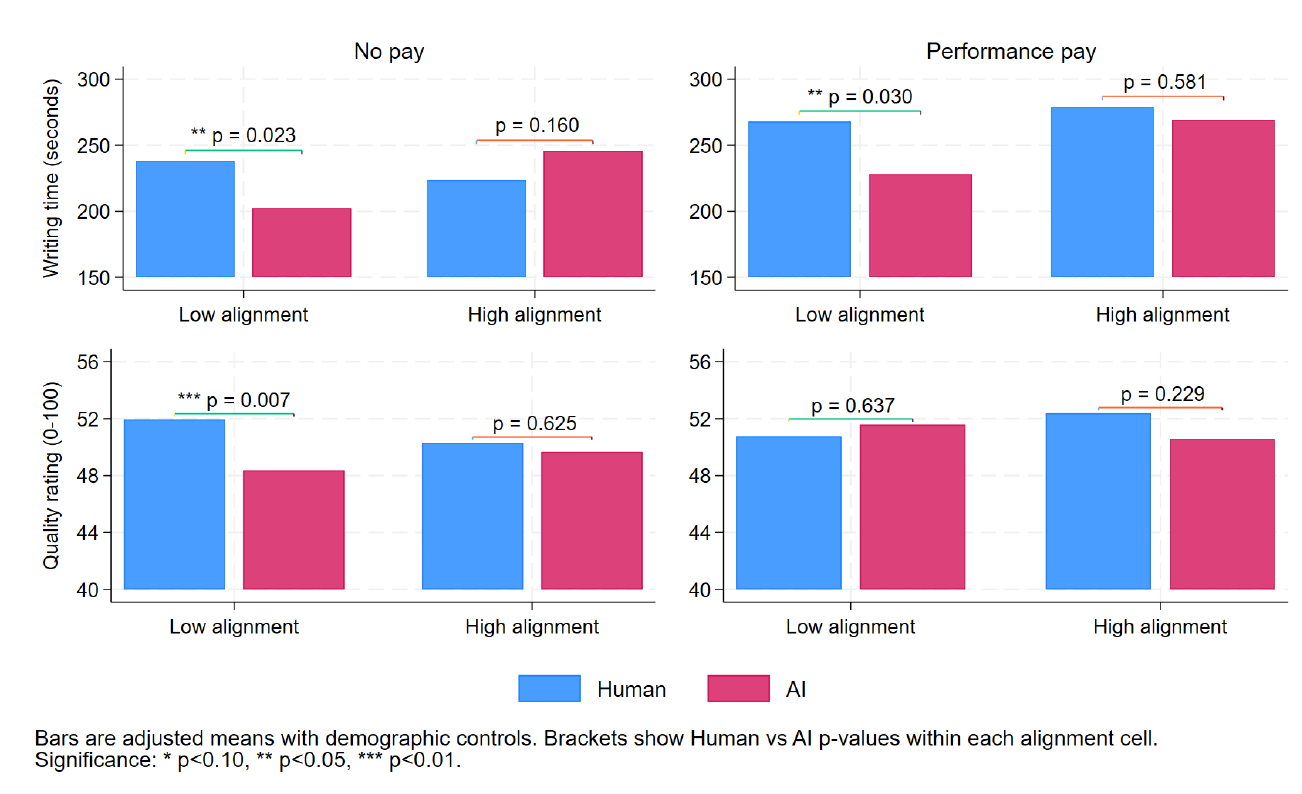
How do workers respond when artificial intelligence replaces human judgment in evaluating prosocial work? Partnering with a non-profit addressing food insecurity, we recruit 1,491 U.S. volunteers to write fundraising messages and cross-randomize evaluation by humans versus AI and the presence of performance pay. AI evaluation reduces effort by 11–14 percent among volunteers with low commitment to the cause, while having no effect on those strongly aligned with the mission. Performance pay fails to mitigate these adverse effects. Workers perceive AI as less effective at identifying quality, which appears to be the primary mechanism, and as less fair and transparent than human evaluation. Introducing an AI algorithm that explicitly applies human evaluation criteria does not mitigate these negative effects, suggesting that resistance to AI evaluation reflects deeper skepticism about machines' capacity for subjective judgment.
@techreport{abel2026algorithm,
  author = {Abel, Martin and Dawi, Raghad S. and Lenk, Tyler and Singer, Aidan},
  title = {Algorithm Aversion in Prosocial Tasks: Evidence from AI-Based Performance Evaluation},
  institution = {IZA},
  note = {IZA DP 18678},
  year = {2026}
}
When an AI rather than a human grades their work, volunteers with low commitment to the cause write for less time and, without performance pay, produce lower-quality messages. Volunteers strongly aligned with the mission are unaffected.
How do perceptions of AI versus human authorship affect engagement with creative work? In an incentivized experiment, participants (N=654) assessed the content of a short story labeled as either human or AI-generated and reported their willingness to pay and work to finish reading it. Consistent with prior research, the AI-labeled story received significantly lower content assessments. However, the time people invest in reading the story and their willingness to pay and work did not differ between the labels, even for the 36% of participants who profess to value human over AI writing. These findings raise questions about whether subjective assessments and aspirations to favor human authorship translate into actions.
@techreport{abel2025bias,
  author = {Abel, Martin and Johnson, Reed},
  title = {AI Bias for Creative Writing: Subjective Assessment Versus Willingness to Pay},
  institution = {IZA},
  note = {IZA DP 17646},
  year = {2025}
}
Formal sector entry-level jobs in Mexico offer low starting salaries but substantial wage growth. This paper experimentally tests whether a six-months wage incentive can increase formal employment among secondary school graduates. Combining survey and high-frequency social security data, the paper shows that the incentive increases formal employment among vocational school graduates by 4.2 percentage points (14.5 percent) over the first two years driven by a 5 percentage point (25 percent) increase in permanent formal jobs. These employment gains are due to both extensive and intensive margin effects. Treatment effects are concentrated among youths with binding reservation wages who also tend to underestimate formal wage growth.
@techreport{abel2024temporary,
  author = {Abel, Martin and Carranza, Eliana and Geronimo, Kim and Ortega, Maria Elena},
  title = {Can Temporary Wage Incentives Increase Formal Employment? Experimental Evidence from Mexico},
  institution = {IZA},
  note = {IZA DP 15740},
  year = {2024}
}
No papers match these filters.
Work in progress
- Barriers to Female Labor Force Participation and Employment in Saudi Arabia (with Rema Hanna, Rohini Pande, Daniela Paz)
- Sectoral Employment Training and Worker Retention (with Anett John)
Teaching
Bowdoin College
- Artificial Intelligence and Economics
- Labor Economics
- Microeconomics
- Detecting Discrimination
Middlebury College
- Economics of Discrimination
- Microeconomic Theory
- Senior Thesis Workshop
Harvard University (Teaching Fellow)
- Economic Development Policy Design
- Introductory Economics (Distinction in Teaching Award)
University of Cape Town
- Econometrics
Student Research
I work closely with undergraduates on original research. Several student projects have become published papers, including a JEBO article coauthored with 17 Bowdoin students.
Senior theses (Middlebury, 2021)
COVID-19 senior seminar projects (2020)
Based on a survey of more than 1,600 respondents across all 50 U.S. states.